


Are Your Ads Reaching the Right Markets? Why Propensity Drives Performance
Destination marketers are always looking for ways to make their budgets work harder. The question isn’t just where to spend. It’s where your spend will actually convert.
New research from Zartico points to a clear answer: market propensity.
Across campaigns, reaching higher-propensity markets consistently leads to stronger conversion rates. The implication is simple: where you target matters just as much as how you target.
What We Found
|
Beyond Visitor Volume
Ranking markets by visitor volume is a natural starting point. But a high-volume market doesn’t always mean high return. Large population centers can drive strong visitation simply due to scale, not because they are more responsive to your advertising.
The real question is whether your spend is reaching the people most likely to visit your destination - a distinction that becomes even more important as targeting becomes more precise. Whether you’re activating at the city, ZIP code, or neighborhood level, performance depends on reaching the right audience, not just a large one.
So what’s the signal that helps guide that decision?
Introducing Market Propensity
As the per-capita rate of visitation to a destination, market propensity measures how likely people in a given area are to visit your destination compared to the average market. It turns geography into a clear signal for where your media is most likely to perform.
Here's what makes it useful:
-
Simplicity. A score of 1 represents an average market. A score of 5 means people there are five times more likely to visit.
-
Precision. It can be calculated at the neighborhood level for ZIP code targeting and out-of-home buys, and aggregated to city or market level for TV, digital, and CTV.
-
Prediction. Historical market propensity is strongly correlated with future campaign performance, making it a planning tool, not just a reporting metric.
Consider the map below. Houston is one of this Texas destination's top origin markets, but propensity tells a more nuanced story. Within the DMA, likelihood to visit varies significantly by neighborhood. By concentrating ad dollars on the highest-propensity neighborhoods, this destination can focus its budget where it will have the greatest impact.
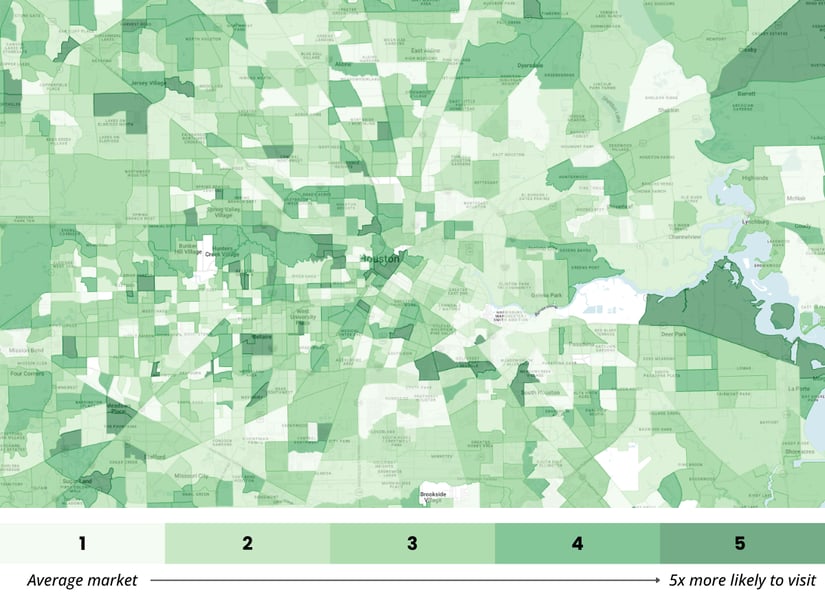 Map of Houston census tracts with propensity values. Darker tracts indicate areas of higher propensity to visit the destination.
How We Tested It
To validate this finding, we studied 15 concluded digital marketing campaigns, measured with Zartico Media Attribution, a tool that connects digital ad exposures to actual destination arrivals, expressed as a conversion rate.
|
The research followed a three-step process:
|
What the Data Shows
In two-thirds of the campaigns studied, the vendors reaching the highest-propensity audiences drove the strongest conversion rates. This confirms that propensity is a meaningful predictor of which tactics will deliver the best results.
Four patterns stood out.
Several advertisers are already operating this way. A handful of campaigns combined the highest conversion rates with the highest propensity scores. These destinations have concentrated spend in high-propensity markets and are seeing the results.
The trend holds across ad formats. We examined whether awareness-focused placements like CTV and video would follow a different pattern than lower-funnel display and native formats. Minor differences exist by medium, but propensity is a consistent signal across all of them.
Niche audiences carry geographic risk. Several vendors activated niche affinity audiences rather than geographic ones. In most cases, these tactics showed lower propensity scores and lower conversion rates than the campaign average.
Why? Interest alone doesn’t guarantee a visit. Travel has a geographic friction that doesn't apply to most consumer purchases. A person may have genuine interest in a destination's content category and still face real barriers of cost, distance, or closer alternatives. Niche channels can be valuable, particularly for destinations with strong national awareness, but evaluate whether those audiences are concentrated in markets with realistic travel potential.
Travel platforms add intent. OTAs and travel publishers tend to outperform their propensity scores. The likely reason is an added layer of travel intent. These platforms combine geographic likelihood with active travel planning behavior. Someone actively browsing hotels or comparing itineraries brings a behavioral signal that propensity alone doesn't capture.
Recommendations
|
What This Means for Destination Marketers
Market propensity gives destination marketers a more intentional way to plan.
It moves beyond raw visitor volume to show not just where visitors are coming from, but where your marketing is most likely to influence behavior.
Every destination has markets that over-index on visitation relative to their population. Communities with strong awareness, close ties, and a demonstrated pattern of sending visitors. These are the markets where marketing builds on existing momentum.
But propensity also reveals something volume alone cannot: markets with the right characteristics that haven’t yet been fully activated. These represent your greatest opportunity for incremental growth.
Opportunity lives in both dimensions. Understanding where you're already strong and where untapped potential exists turns media planning into a more deliberate strategy.
The goal isn’t just to reach more people. It’s to reach the people most likely to come.
Jay Kinghorn is Chief Innovation Officer and Co-Founder at Zartico, where he helps destinations unlock the power of data to optimize marketing performance and communicate impact with clarity.