


World Cup-Ready: What 94 Mega-Event Matches Teach Us About Capturing the Economic Moment
Executive Summary
The World Cup will bring the crowds. But will it bring lasting economic impact to your community?
Leveraging Zartico’s integrated data sets, we analyzed 94 mega-event matches to understand what converts event attendance into localized revenue and how any FIFA World Cup 2026 host city can maximize the value of events to their community.
From nearly 3.4 million fans, five themes emerged. Together, they form a blueprint to help destinations capture more revenue and measurable economic impact:
- Visitors drive impact. Residents largely redistribute existing spend.
- Food and beverage is the clearest signal of lift. Event-driven revenue shows up first and most consistently at restaurants and bars.
- Convenience converts fans into spenders. Walkability can mean the difference between a 36% spending lift and 3%.
- International visitors amplify results. Build on domestic fundamentals and treat global travel as upside.
- Downtime is the multiplier. The days between matches may generate more value than the match itself.
The match lasts 90 minutes. The economic opportunity lasts much longer, if you design for it.
Read the full analysis to explore the data, methodology, and recommendations for maximizing event-driven impact.
The Opportunity
Every World Cup host city has seen the headline projections: billions in economic impact across the United States, Canada, and Mexico. But for the DMO director in Atlanta, the event organizer in Dallas, or the restaurant owner three blocks from AT&T Stadium, the real question isn’t how big the World Cup is. It's how much of that impact lands in your community.
It's a question that extends well beyond the World Cup. Whether you're hosting a World Cup semifinal, a college football rivalry weekend, or a regional youth soccer tournament, the same economic dynamics are at play. What share of your attendees are visitors? How easily can they spend near your venue? Where does the money actually land? The scale of the event changes, but the patterns remain consistent.
To answer these questions, Zartico analyzed 94 matches across the 2025 FIFA Club World Cup, the 2025 CONCACAF Gold Cup, and the 2025 and 2026 NFL Super Bowls. Close to 3.4 million fans across 26 venues in 20 cities. Five themes emerged.
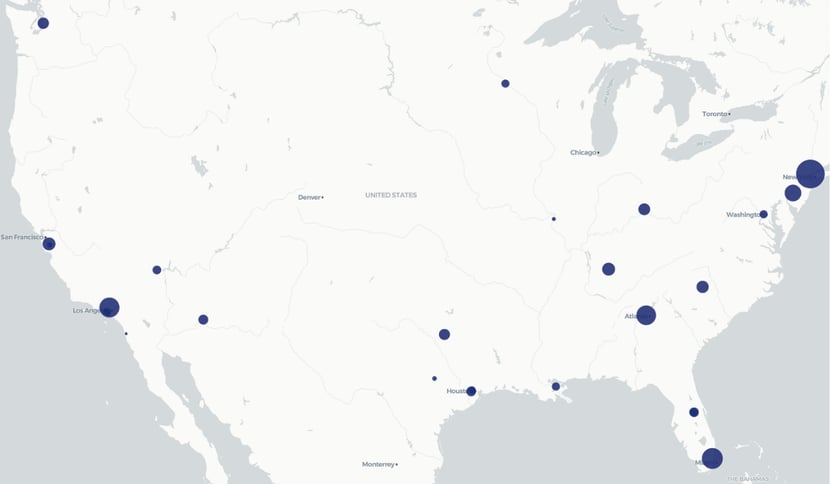 Map of venues included in the study. Size based on total event attendance.
Theme 1: The Visitor Effect
The single most important factor in event-based economic impact is the number of visitors traveling for the event. We call it the Visitor Effect and it anchors all of our event analyses.
Why? Event impact measurement focuses on spending occurring because of the event that wouldn’t have happened otherwise. A resident attending the game and grabbing dinner nearby is largely substituting one spending location for another. They aren't adding new revenue. A visitor brings entirely new dollars like spending on hotels, meals, and shopping. Every dollar they spend is incremental to the local economy.
Most regular-season sporting events average 15-18% visitor attendees. Across the 92 soccer matches, visitors averaged 26%, reflecting the draw of marquee international clubs in a high-stakes tournament. One in four fans accounted for the vast majority of measurable economic impact. That's the Visitor Effect.
Visitors also spend differently. Across all matches, visitors spent 31% more per cardholder on food and beverage (F&B) than residents in the event impact area. At Allegiant Stadium in Las Vegas, visitors spent $109 per cardholder on F&B, double the $53 residents spent. At MetLife Stadium just outside of New York City, visitors spent $54, barely more than the $49 from residents. In Vegas, a visitor behaves like a traveler. At MetLife, a visitor spends like a local.
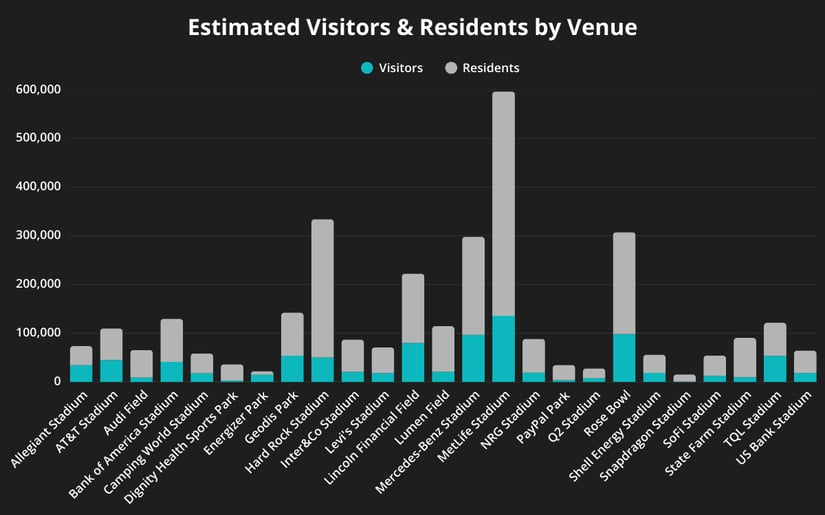 Stacked bar chart of estimated visitors and residents by venue.
This chart shows the visitor and resident composition at all CWC and Gold Cup venues. Notice that Mercedes-Benz Stadium in Atlanta hosted nearly as many visitors as MetLife Stadium, despite having roughly half the total attendance.
Three factors account for the variance:
|
Related: This Night is Sparkling: Swifties and the Impact of The Eras Tour
Theme 2: Spending Patterns & Event Lift
If visitors are the engine of event impact, where does their spending show up?
Using our Event Impact Area methodology (detailed below), we evaluated spending across event-related categories at progressively wider radii from each stadium. We looked at resident spending on match day only; while visitor spending includes one day on either side to account for arrivals and overnight stays.
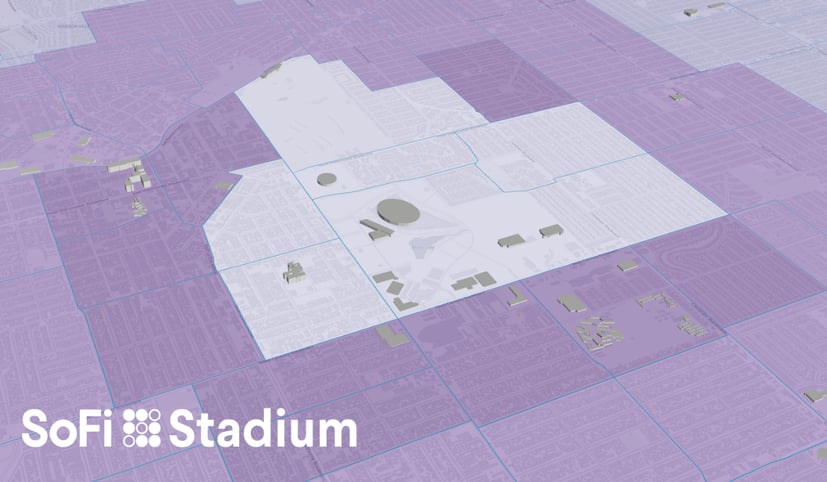 A visual of SoFi Stadium with Event Impact Area methodology applied.
Across all 92 matches, resident spending was essentially flat on match days compared to baseline, hovering within a percentage point of zero regardless of radius. Visitors were the only segment that generated meaningful lift, and that lift grew with distance: nearly +5% at the 5-mile radius, as spending rippled outward into surrounding restaurants, shops, and hotels.
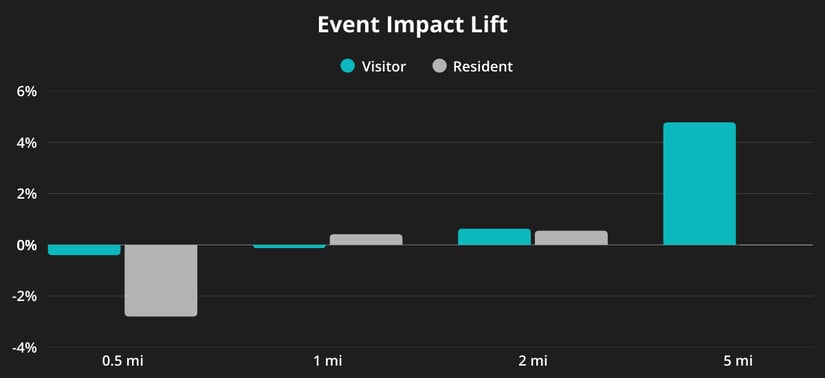 Event impact lift for visitors and residents by radius.
When destinations evaluate event impact, hotel occupancy tends to dominate the conversation. But our data shows that F&B was the most consistent beneficiary of event-driven visitor spending, with a median lift of nearly 4% across all matches at the 5-mile radius. It showed up at virtually every venue type: urban, suburban, large market, and small market. F&B is the universal signal of event impact. Visitors eat and drink in the community, whether they're staying one night or three.
Event success is not solely measured by hotel occupancy near the stadium. The visitor dollar shows up first and most reliably at restaurants and bars.
But how much of that F&B spending your community captures depends on one factor: how easy it is for fans to keep spending after the final whistle.
Theme 3: The Convenience Economy
We expected New York and Miami to top the spending lift standings. They hosted marquee names and the biggest matches. But their lift metrics were lower than Atlanta and Dallas. Why?
What separates them is convenience. Mercedes-Benz Stadium and AT&T Stadium are walking distance to restaurants and bars. MetLife Stadium and Hard Rock Stadium require getting back in your car. That friction is measurable: at AT&T Stadium, visitor F&B spending lifted 36% above baseline. At MetLife, just 3.5%. Over a busy tournament, that difference accounts for millions of dollars.
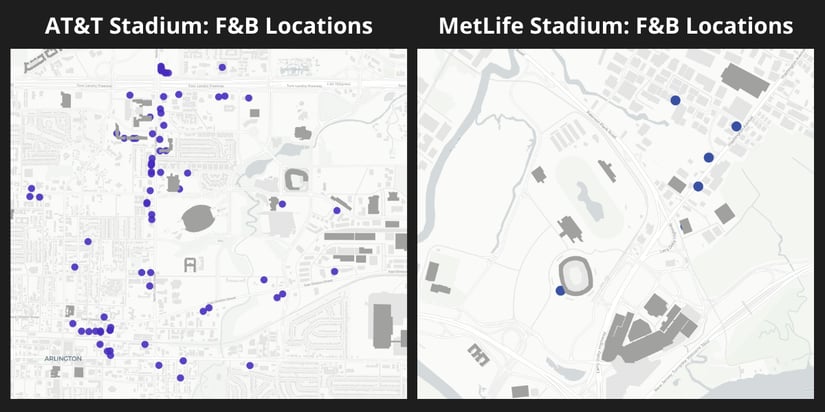 Comparison of F&B Places within 1 miles from stadium at AT&T Stadium vs MetLife Stadium.
The game wraps, and you’re ready to celebrate. At a walkable venue, you step outside and the evening continues. At a suburban stadium, you walk to your car, fight traffic and find a new parking spot. That drag on spending is real and consistent across all 92 matches.
An increasing trend nationally is to develop entertainment zones adjacent to sports facilities. Our data supports the economic case for these investments. Walkable venues consistently outperformed suburban venues in localized spending lift.
The Super Bowl puts this in perspective. Both the 2025 game in New Orleans and the 2026 game in Santa Clara generated similar visitor F&B lift, 55% and 52% respectively. But in New Orleans, 96% of that spending landed within 1 mile of the Superdome. In Santa Clara, only 60% landed within that same radius. The rest scattered across a 5-mile area as fans drove to find restaurants and bars.
An event the size of the Super Bowl is big enough to overcome friction. But for most World Cup matches, particularly group stage games, the math is less forgiving. Communities with walkable options near the stadium will capture more of the visitor dollar. Those without them need to create them.
Most World Cup host communities are already planning for this. Fan zones, food and beverage activations, and live entertainment adjacent to stadiums are in the works across host cities. Our data reinforces why these investments matter. They aren't just atmosphere. They are the mechanism that converts event attendance into localized economic impact.
Related: Visit Salt Lake NBA All-Star Weekend
Theme 4: International Lift
Thus far, we've focused on domestic attendees. The World Cup is an undeniably international event, perhaps matched only by the Olympics.
Even in the Club World Cup and Gold Cup, we measured a 23% lift in international visitors in the 5-mile event impact area compared to baseline. Both tournaments were effective international draws, setting a floor for what host communities should expect this summer.
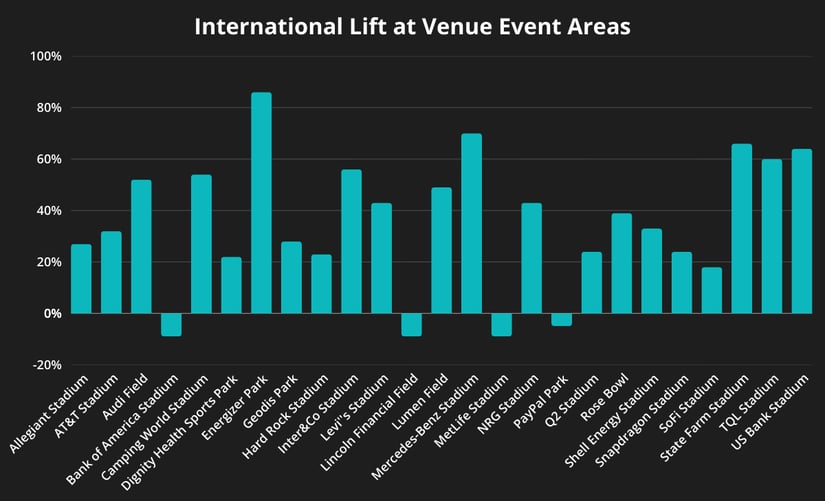 International lift at venue event areas.
The variation was significant. Energizer Park in St. Louis posted an 87% increase in international visitors. Mercedes-Benz Stadium saw a 70% lift, the Rose Bowl 39%, Allegiant Stadium 28%. The pattern: matches featuring teams with large, geographically dispersed fan communities generate the strongest international lift. In St. Louis and Las Vegas, Gold Cup matches with the US and Mexico activated national fan bases. In Atlanta, Manchester City and Paris Saint-Germain drew on global club followings. This dynamic will intensify when national pride replaces club loyalty as the motivator for travel.
This is also where uncertainty is highest. Key international visitor markets slowed or contracted in 2025. Canada, the largest source market, declined significantly, and all Canadian group stage games will be held in Canada. Other major soccer nations showed mixed signals: UK, Brazil and Spain were flat; France and Germany declined.
History suggests the magnetic appeal of a World Cup overcomes these headwinds, but smart planning doesn't depend on it. Build your strategy on the domestic fundamentals we've outlined. International visitors will amplify the impact, not define it.
Theme 5: Downtime - The X-Factor
Imagine waking up in your hotel room with an entire day to explore the city before tonight’s 7 pm match, your entire day ahead of you: sightseeing, shopping, lunch on the go, pre-game drinks. Every one of those visitor dollars is incremental economic impact.
What makes the World Cup unique is the length and density of the tournament. Matches in the same city are spaced days apart across a month-long run. Fans may attend two or three matches in a week, or travel between host cities following their national team. For international visitors, especially, this is a once-in-a-lifetime trip that justifies a longer stay and broader exploration.
We don't have a direct precedent in our data for multi-match trips. But across the many events we've analyzed, downtime is consistently an impact multiplier. The more time visitors spend in your community, the more they spend.
For World Cup host cities, the economic opportunity extends well beyond the 3-hour match window. The visitors who arrive early, explore on off-days and stay after their last match will likely generate more spending in the surrounding community than they do at the stadium itself.
Making it easy and appealing for visitors to explore, through clear visitor information, accessible transit and visible programming, is how you capture the full value of being a World Cup host city.
Conclusion: Five Takeaways for Event Host Cities
We set out to study what 94 mega-event matches can tell us about what's coming this summer and how any event city can maximize the value of events to their community. What we learned were key themes that create a blueprint to help capture more revenue and economic value.
|
The World Cup will be bigger than any of the events we studied. But the structural patterns we observed will hold. The cities that tailor these recommendations to their local visitation and geography will capture the most value.
How We Measured It
Measuring close to 100 events across the country required a methodology flexible enough to handle everything from Gold Cup qualifiers with 2,400 attendees to the CWC Final with 81,118 fans, and precise enough to isolate localized impact in metro areas as large as New York and Los Angeles.
We built our approach on three pillars:
|
Event Attendees: Domestic geolocation devices observed at the stadium on match day, normalized using Zartico's patented processes to measure resident and visitor composition at each match. Event Impact Area: Visitor spending at merchants within ½-mile, 1-mile, 2-mile and 5-mile radii from each stadium, compared to a pre-tournament baseline. International Attendees: International devices transmit location observations at far lower frequency than domestic devices. For reliability, we measure international device presence in the 5-mile event impact area and compare to baseline periods. |
We applied this methodology to 92 Club World Cup and Gold Cup matches, then complemented the soccer tournaments with the 2025 and 2026 Super Bowls - events that match the spectacle and global attention that World Cup knockout rounds will bring.
Look for updates from us after the World Cup concludes this summer.
Methodology Appendix
Data Sources
- Geolocation: Zartico’s domestic and international geolocation data
- Spending: Normalized transaction data within defined venue radii
- Event inventory: 62 Club World Cup matches, 30 Gold Cup matches, 2 Super Bowls
Key Definitions
- Visitor: Device observed 50+ miles from home location (domestic) or any international device
- Event attendee: Device observed at stadium POI during on match day
- Event Impact Area: Domestic visitor and resident spending at merchants at zip codes within 0.5, 1, 2, 5 miles from the event venue. Online transactions and those that cannot be associated with a location (e.g. transactions through rideshare app) excluded from the analysis.
- Spending lift: Match day normalized spend vs. same-day-of-week baseline from May 17 - June 13. Super Bowl lift used DOW matched weekends. 2025 Super Bowl DOW-matched weekends (Jan 11-13, 2025, Jan 18-20, 2025, Jan 25-27, 2025). 2026 Super Bowl (DOW-matched weekends ( Visitor Window: Jan 10-12, 2026, Jan 25-27, Jan 31 - Feb 2).
- International lift: % change in international device presence in 5 mile Event Impact area vs. baseline
Jay Kinghorn is Chief Innovation Officer and Co-Founder at Zartico, where he helps destinations unlock the power of data to optimize marketing performance and communicate impact with clarity.
Stay ahead with Zartico’s Essential Intelligence. Curated insights at the intersection of data, marketing, and place-based strategy. No noise, just the intel you need to make smarter decisions. Sign up here for our quarterly newsletter.