


You've Always Known What a Great Campaign Should Do. Now You Can Prove It.
For most of my career in destination marketing, campaign success looked the same: hit your impression targets, drive traffic to your website, report on estimated hotel nights and land on an ROI number you could defend in front of your board. Those success metrics weren't wrong, but our industry now has the tools to do better.
The question I want to explore here isn't whether your media worked. Did your campaign achieve what you actually set out to do for your destination?
Getting More Specific About Success
Destination marketers have always built campaigns around specific traveler personas. A culinary campaign to target food-motivated visitors, the ones filling restaurant seats and returning for the dining scene. An outdoor adventure campaign to reach a different audience entirely, one whose trip revolves around trails, waterways, and active experiences.
The challenge has always been proving that success. You had proxies including website traffic, occupancy lift, maybe a post-trip survey, but nothing that closed the loop. But whether your foodie campaign actually sent more people to restaurants than a non-exposed visitor? The data simply didn't exist.
One of the things I find most compelling is that we now have data that supports this level of insights. If you run a culinary campaign, you can now see whether those ad-exposed visitors showed up at restaurants at a higher rate than visitors who never saw the ads. If your campaign was built around outdoor adventure, you can know whether those visitors over-indexed at parks and recreation points of interest. That comparison should be standard in campaign reporting.
| Whether your creative and targeting actually shaped what people did once they arrived is not a nice-to-have insight. It is the insight. |
The same logic applies to regions within your destination. Most DMOs have areas they are actively trying to grow or distribute visitation toward, and now you can see whether your media is reinforcing the destination experience you are trying to build or simply adding volume without direction.
Distance adds another layer to this. Drive market visitors and fly market visitors don't just come from different places. They experience the destination differently once they arrive. In some recent client campaigns we’ve analyzed, drive market visitors over-indexed at outdoor recreation and entertainment districts, while fly market visitors were more likely to show up at accommodations and food and beverage establishments. Understanding those behavioral differences helps marketers make smarter decisions about targeting, creative, and how they tell the story of campaign impact.
The Questions Your Campaign Should Be Able to Answer
Media Attribution can now answer questions like:
-
Which origin markets are actually converting, not just receiving impressions?
-
Which vendors drove the highest percentage of exposed visitors to show up in-destination?
-
Which creative connected with people who actually made the trip?
-
Where are we overspending relative to real-world impact?
-
What percentage of visitors who came would have shown up anyway, without the campaign?
That last question might be the most important one. Knowing your baseline conversion rate is what separates a defensible ROI claim from an inflated one. It's the number that makes all the other numbers honest.
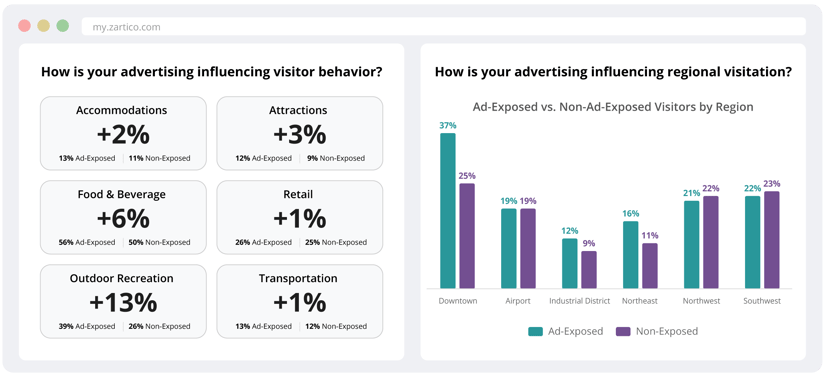 Zartico Media Attribution measures the true impact of digital advertising on destination visitation.
A Higher Bar
The destination marketing industry is good at accountability. DMOs answer to boards, city councils, hotel partners, and other stakeholders. What I'd love to see is that same accountability applied to a more complete set of goals… not just reach and ROI, but behavioral outcomes. Not just who came, but where they went and what they did.
The data to answer those questions exists. The question now is whether we're asking them.
Ready to turn guesswork into precision? Schedule a demo and discover what’s possible with Zartico.