


Four Ways Discover Green Bay Turns Event Data Into Funding
Most event reports arrive after the confetti is swept up. They confirm the event went well. Then they sit in a folder.
Discover Green Bay uses their event data differently. The team behind the 2025 NFL Draft treats every event analysis as the opening argument for the next funding request. It has helped bring nearly $5.8 million in funding to their community, and it has made them the first call when local leaders weigh where event dollars should go.
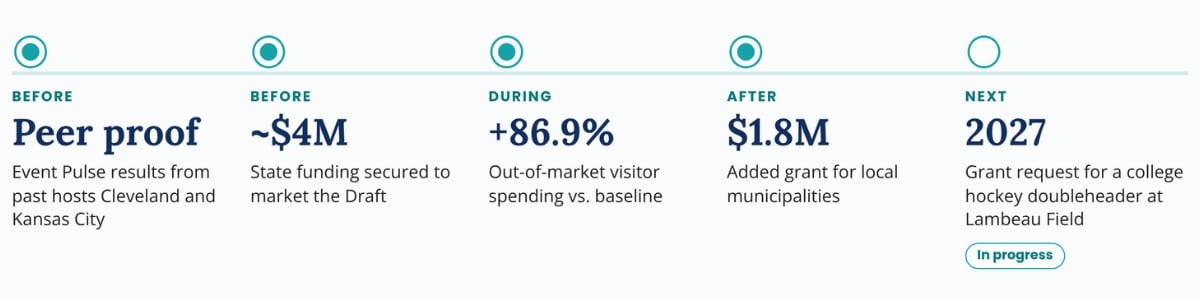 Timeline of Discover Green Bay's NFL Draft funding, from peer proof and ~$4M in state funding to an 86.9% visitor spending lift and a $1.8M grant.
At our October Zartico Connect, Brad Toll, President & CEO, and Nick Meisner, VP of Digital Marketing & Communications, at Discover Green Bay shared how they do it.
Here are four strategies any destination can put to work.
1. Borrow Proof Before You Have Your Own
No city hosts the NFL Draft twice in a row. That means every host walks in without a track record. Green Bay solved that by leaning on the experience of others. The team used data from past Draft hosts Cleveland and Kansas City to project what visitors would spend. That case helped secure just under $4 million in state funding to offset marketing costs before a single fan arrived.
| When to use this: You're bidding on or funding a first-time event. Find comparable events in comparable markets and let their results make your case. |
2. Turn the Results into the Next Ask
The Draft drew more than 600,000 attendees. Out-of-market visitor spending rose 86.9% over baseline. When local municipalities faced security cost overruns, Discover Green Bay brought that evidence to the table. The village of Ashwaubenon, the city of Green Bay and Brown County secured an additional $1.8 million grant.
The same thinking carries forward. After Badgers vs. Notre Dame at Lambeau Field, out-of-market visitor spending rose 27.7%, and Chicago gained more visitor share than any other market. The team is now using those patterns to pursue a Travel Wisconsin grant for a February 2027 college hockey doubleheader. If South Bend traveled for Notre Dame, Columbus and Ann Arbor will travel for Ohio State and Michigan.
| When to use this: Any time an event resembles one you've already measured. Origin markets and spending patterns are portable evidence. |
3. Put One Number in Front of Officials Every Month
Discover Green Bay sends a monthly Tourism Impact update to every elected official in its area, from town boards to city council. Each issue features one snapshot from their visitor data, like top origin markets or where visitors spent. The format changes every month, so it stays fresh.
"It establishes us as being the experts in the community," said Brad Toll. When a municipality is asked to fund a festival, officials now call Discover Green Bay first.
| When to use this: Start sharing data before you need anything. Trust built in the quiet months pays off when budgets get tight. |
4. Measure the Small Events Too
Not every insight comes from a stadium. Pulaski, a village with one hotel, partners with Discover Green Bay through its room tax dollars. Its Polka Days festival is a beloved staple, and its visitor spending holds steady year over year. The state archery tournament told a different story: a 48% lift in out-of-market visitor spending.
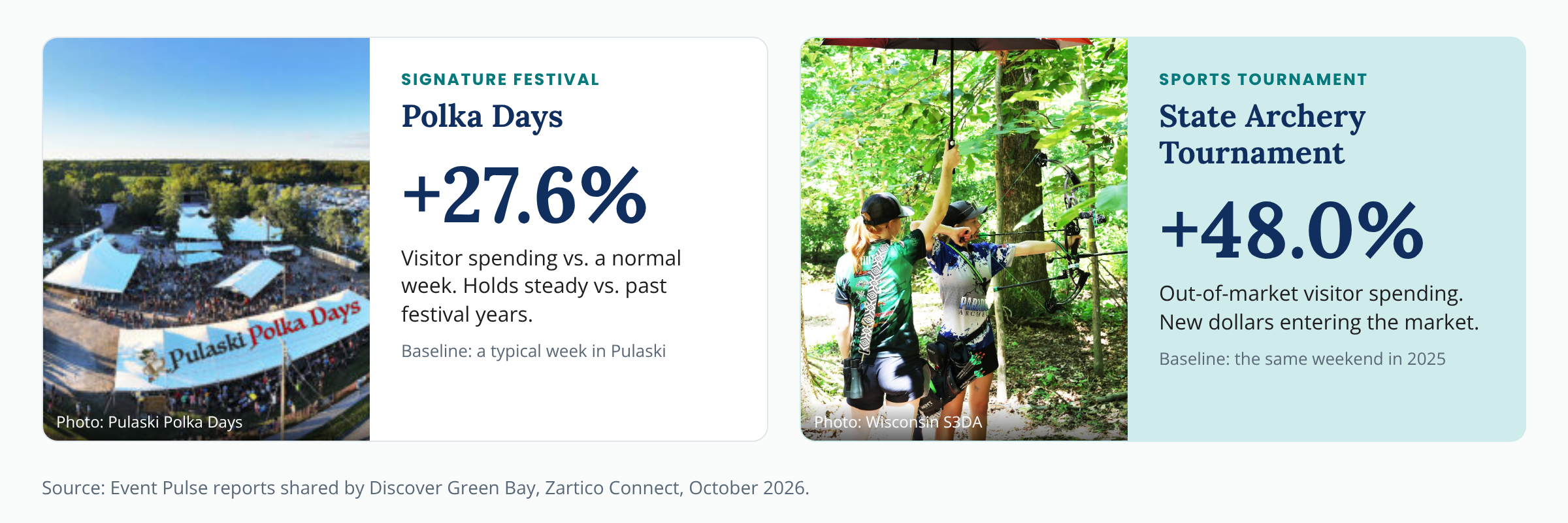 Pulaski's Polka Days drove a 27.6% visitor spending lift while the state archery tournament drove a 48% lift in out-of-market visitor spending
That kind of finding changes the conversation. Instead of putting every dollar behind the event everyone already knows, a small town can invest in the events that actually bring new visitors. The same approach helped Discover Green Bay form a second tourism zone and room tax commission among communities outside the core.
| When to use this: When smaller partners ask whether tourism investment is worth it. Show them what similar events did for their neighbors. |
One More Lesson From the Draft
Weeks of local news warned residents about traffic and told them to stock up on groceries. The transportation plan worked. Highways averaged 65 miles per hour. But resident spending still dropped 12.9%. A strong operations plan needs equally strong public messaging.
The Takeaway
The most valuable event report is the one you use before the next event. Discover Green Bay didn't just measure what events were worth. They made that evidence the foundation of every funding conversation.
"It isn't just my gut feeling anymore. I can actually show data that proves that what we're saying is correct."Brad Toll, President & CEO, Discover Green Bay |
|
SHARE THIS STORY Take Discover Green Bay’s Story to Your Stakeholders Download the case study to share with your board, funders or event partners. |
See what your events are really worth. Explore Event Pulse.